


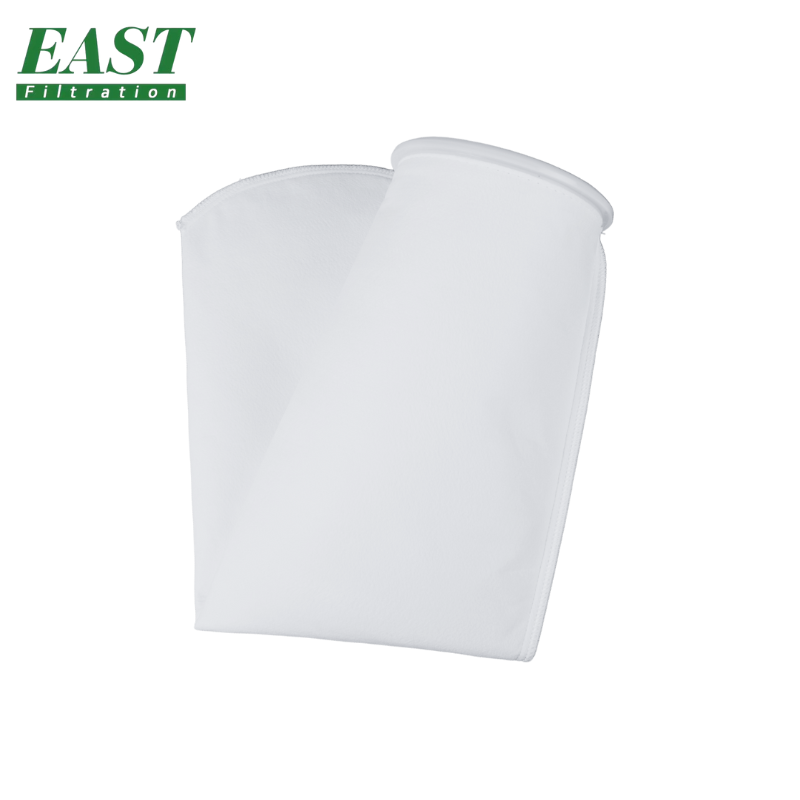


Polyester 7 x 32 in filter bag - filter bag manufacturer
Material: food grade polyester non woven felt-needle punched felt
Micron rating: 0.5-200um
Features: 3D space inside ofnon-woven fibers, capture small particledirectly, high effciency, low cost, large capacity of dirty particles,excellent air permeability.
Material: Polyester extended life felt
Features: made by more micro fiber. Dirty capacity can be 4 times thangeneral felt. Longer life time, Larger capacity.
Send Inquiry
Technical Parameter
Reduce change-out frequency and cut maintenance downtime. Contact our experts for an engineered filtration solution!
Product Overview
Size #02 is the large-format bag in our extended-life polyester range, built for standard housings that take a 7 in diameter by 32 in long bag. Two needle-punched felt layers do the work: a food-grade polyester base carries the strength and the shape, and a finer extended-life layer is needled onto the dirty side to catch solids earlier and hold more of them before the media blinds over.
Most plants order it for one practical reason — it turns a frequent change-out into a scheduled one. On a stream with a steady solids load the extra depth keeps flow moving while the bag fills, so operators open the housing less often and the line stays up. The same qualities make it easy to stock: one part number covers a lot of the housings already on the floor, and the micron rating is chosen when you order rather than when you fit.
Process engineers and maintenance teams run it on chemical, food and beverage, and water treatment duty. We supply the size to plant buyers and to distributors, and as a filter bag supplier we hold both the standard micron steps and the media alternatives on the same production line, so a reorder does not mean re-qualifying a new source.

Size Option
· Size #01: 7 in diameter × 17 in long, 0.25 m² filter area, 8 L volume, listed maximum flow 20 m³. The short version of the same polyester filter bag, for shallow baskets and lower flow duty.
· Size #02: 7 in diameter × 32 in long, 0.5 m² filter area, 17 L volume, listed maximum flow 40 m³. The bag on this product — full-height housings, the heaviest dirt load and the longest interval between changes.
· Size #03: 4 in diameter × 9 in long, 0.09 m² filter area, 1.3 L volume, listed maximum flow 6 m³. Small-basket housings on pilot lines, sampling points and small transfer pumps.
· Size #04: 4 in diameter × 15 in long, 0.16 m² filter area, 2.5 L volume, listed maximum flow 12 m³. The same 4 in rim as #03 with more depth, so the bag lasts longer at the same rating.
· Size #05: 6 in diameter × 20 in long, 0.2 m² filter area, 3.8 L volume, listed maximum flow 18 m³. The middle size for 6 in baskets that cannot take a full 32 in bag.
· How to choose: match the basket first, then the solids load. A larger bag at the same micron always buys more time between changes, but only if the housing has the depth for it. Every size in the chart is available in this construction, and Size #02 is our largest standard industrial filter bag.

Bag Material Option
· Polypropylene (PO and extended-life POXL): the economical felt for cool chemical streams, with good resistance to many acids and alkalis but a lower working temperature than polyester. The XL version adds a microfibre layer for heavier solids.
· Polyester (PE): sits above polypropylene on working temperature, and the food-grade grades suit beverage, food and warm process lines.
· Extended-life polyester (PEXL): the media in this bag, specified when a polyester-compatible stream also carries a heavy particulate load.
· Nomex (NT) and PTFE: the hot end of the range — Nomex for high-temperature process streams, PTFE for the most aggressive chemistry and the highest temperatures, including solvent-heavy industrial filter bag duty.
· Nylon monofilament (NMO): a woven mesh that holds particles on the surface rather than in the depth, which suits fibrous or gelatinous solids that would otherwise blind a felt bag.
· Oil-absorbing polypropylene: for streams where free oil rather than particulate is the problem.
· Non-standard builds: as a filter bag manufacturer we cut and weld to the micron rating, media and size your process needs, so a rating between the usual steps is still orderable.
· Custom filter bags: if the basket is not a stock size or the fluid sits between two media, we build to your drawing rather than asking you to change the housing.

Product Advantages
Longer intervals between change-outs.
The extended-life layer holds up to four times the dirt of general felt, so a bag that used to be changed every shift can be planned on a weekly routine. In a housing that is opened by hand, that is the single biggest lever on maintenance hours.
A pressure curve you can plan around.
Because solids are trapped through the depth rather than on the surface, differential pressure rises smoothly. Operators can set a change-out point and trust it, instead of reacting to a sudden drop in flow.
Downstream protection.
A welded seam and a correctly seated rim close the two paths that let unfiltered liquid past a filter bag. Cartridges, membranes and heat exchangers behind the housing see fewer excursions, and the process sees fewer quality holds.
Lower cost per cycle, not just per bag.
Fewer change-outs means less labour, fewer housing openings, less product lost at each change and less spent media to handle. On a busy line the arithmetic usually favours the extended-life bag well before unit price does.
Steady quality between lots.
Needle-punched felt runs in controlled batches and the micron rating is set at cutting, so filtrate from one delivery matches the last. For plants working to a written specification, that repeatability matters more than a small difference in bag price.
Simpler shelves for resellers.
Distributors carry fewer part numbers when one extended-life bag covers most of their 7 in housings, and the shared sizing across media means a customer who changes fluid does not need a different bag programme.
Housing Fit & Installation
1. Measure the basket first: inside diameter and usable depth. A 7 in × 32 in basket takes Size #02; a 7 in × 17 in basket takes Size #01.
2. Check the rim seat. The rigid rim should rest flat on the housing support ring with the collar trapping it. If the old bag sat on a spring, a perforated basket or an unusual collar, send a photo of the rim before you order.
3. Match the media to the fluid. Temperature and chemistry decide whether polyester, polypropylene, Nomex or PTFE is right for your liquid filter bag, and the micron rating follows the particle size you need to remove.
4. Seat the bag properly. Open it out fully, press the rim down evenly, and make sure no felt is trapped under the collar — a fold there is the usual cause of bypass.
5. Close and pressurise slowly. Bring the bag filter housing up to line pressure gradually and watch the first minutes of operation at the rim.
6. Record the clean differential pressure at start-up, then plan the change on that baseline rather than on a fixed calendar.
7. Keep one spare set per housing on site. A planned change costs minutes; waiting for a delivery costs a shutdown.
8. Never force a filter bag that does not sit flat. A bag that is too long for the basket creases at the base and blinds early, and a bag that is too short leaves the basket wall exposed to bypass.
Applications
· Chemical processing: acids, alkalis, solvents and catalyst recovery. The bag takes the particulate load ahead of the process and lets you recover solids from the spent stream.
· Food and beverage: juice, beer, wine and other beverage streams. Food-grade felt removes suspended solids and yeast ahead of filling, with no binder to migrate into the product.
· Water and wastewater: industrial wastewater, circulation water and wash-down streams. Grit and scale are captured before they reach pumps, valves and downstream cartridges.
· Automotive and metal finishing: degreasing, phosphating and cleaning baths. Sludge and metal fines come out of the bath so the chemistry stays in range and parts finish evenly.
· Electronics and semiconductor: ultrapure water and chemical solvents. The finer ratings carry this liquid filter bag into lines where a single stray particle can spoil a batch.
· Pharmaceutical and biotechnology: process liquids and extracts, where particulate is removed ahead of final purification and the media has to be consistent from lot to lot.
· Oil and gas: produced water, crude and gas processing streams, where a robust industrial filter bag has to stand up to continuous duty and change-outs are expensive to schedule.
· Coatings, inks and resins: skins, pigment agglomerates and overspray are removed before the material reaches a coating head or a print unit.
· Distributors and resellers: these are the industries that keep Size #02 moving, and we support the accounts that stock it as a filter bag supplier with the same media lot across reorders.
Ordering & Delivery
1. Send the housing details — inside diameter, usable depth and the rim or collar style you use — together with the fluid, its working temperature and the particle size you need to catch.
2. Tell us the micron rating you want. If you are between two, describe the solids and we will recommend the tighter or the looser option.
3. Ask about a trial bag for your housing before a full order, and confirm availability and current lead time with your sales contact at that stage.
4. If the basket is non-standard or the micron sits between the usual steps, we quote custom filter bags against your measurement or drawing.
5. Read the order acknowledgement. As a filter bag manufacturer we confirm media, size and rim in writing before production, so compare it with your own measurement.
6. Agree packing and labelling with your sales contact. Bags are normally supplied flat-packed in sealed outer cartons; carton quantity, pallet configuration and any printed artwork are set at quotation.
7. Confirm payment terms, shipping method and delivery schedule with your sales contact when you order — media, size and quantity all affect both cost and timing.
8. For repeat programmes, tell us the sizes and quantities you expect to use each quarter. As a filter bag supplier we plan production so reorders come from the same media lot with the same lead time.
Change-Out & Care
Set the change point on pressure, not on the calendar.
Note the clean differential pressure the first time the housing is brought up to line pressure, then set your change point against that baseline — usually when the gauge climbs to the limit your pump and downstream cartridges can tolerate. A bag at the end of its life shows steadily rising pressure and falling flow. If the pressure drops away while the filtrate turns dirty, the rim has most likely come unseated rather than the bag being spent.
Take it out in one piece.
Isolate the bag filter housing, vent it and drain it before the cover comes off. Lift the bag by the rim, let it drain into a tray, and carry it upright to waste. Whatever it has collected — metal fines, pigment agglomerate, yeast, catalyst — determines how the spent bag has to be disposed of on your site, so treat it as process waste and not as general refuse.
Do not wash, wring or refit.
Needle-punched felt is a depth medium: the solids sit lodged through the fibre structure, not on the surface, so backflushing, pressure washing, wringing or drying in the sun will not open the felt back up to its rated micron. A bag that has been wetted and dried also loses the rim shape that seals against the collar, and a refitted polyester filter bag is the usual starting point for bypass. On food and beverage duty, single use additionally removes any question of carryover from the previous batch.
If reuse is the real requirement, change the media.
Where a plant genuinely needs to clean a bag and put it back, the correct product in our range is the nylon monofilament bag: surface filtration on a woven mesh, supplied in 25, 50, 100, 500 and 1000 μm, washable between cycles, with a seam steel ring in the #01 and #02 sizes for a secure seat in high-flow systems. Keep the polyester for streams where depth loading is the whole point and the bag is meant to be consumed.
Store spares flat, dry and in rotation.
Unopened bags belong in their cartons, laid flat, in a dry store away from direct sunlight, solvent or oil fumes, hot pipework and anything heavy that would crease a rim. Do not hang them on hooks. Rotate oldest stock first so the felt at the back of the shelf is not the felt that reaches the housing, and hold at least one spare set per housing so a planned change stays a planned change. As a filter bag supplier we can pack a quarter's usage into one sealed carton if that suits your stores.
When a bag blinds early, look at the duty first.
A bag that loads in hours rather than days is usually being asked to do the wrong job: the micron rating may be tighter than the solids load allows, the stream may carry fibrous or gelatinous material that belongs on surface media, or the housing may simply be too small for the flow. Moving one step looser, adding a coarser industrial filter bag ahead of this one, or switching to nylon monofilament will solve more of these cases than any change in cleaning routine.
Testing & Compliance
Our Shanghai factory's credentials include ISO9001 quality management, ISO14001 environmental management, CE and SGS third-party testing, and we keep those documents current for buyers who need them on file. Tell us which standard your market or end customer works to, and we will confirm the applicable certificates and test reports and send copies with the order documents. If your own supplier audit needs specific records, request them at the quotation stage so we can prepare everything in advance.
Use to

FAQ
Q1. What is the bag made from, and is the felt food-grade?
Food-grade polyester non-woven felt, needle-punched into a dense sheet, with a finer extended-life layer needled onto the base. Nothing is held together by glue, so there is no binder line to soften or migrate during service, and the seams are welded rather than stitched. This polyester filter bag is built for liquid duty where the media has to hold a heavy solids load without shedding fibre downstream.
Q2. What is the difference between the standard polyester bag and the extended-life version?
The base media is the same; the extended-life version adds a layer of finer microfibres on the dirty side, and that layer is where the extra dirt-holding capacity comes from. Choose it when the solids load is high enough that a standard felt liquid filter bag blinds before the shift ends. On a light load, the standard felt is perfectly adequate and costs less per bag.
Q3. Can you make this bag in a non-standard size or micron rating?
Yes. Micron rating, media and size can all be changed, and we regularly build custom filter bags to a basket measurement or a target particle size — including sizes outside the standard chart and ratings between the usual steps. Send the measurement from your basket, or a drawing, and note whether the rim has to match a particular collar profile.
Q4. Will it fit the housing we already have?
If your housing takes a 7 in × 32 in bag, Size #02 drops straight in — no adapter, basket change or piping work. The bag is made to standard bag filter housing dimensions and the rigid rim seats on the usual support ring. If your housing uses a spring, a perforated basket or an unusual collar, send a photo of the rim and we will confirm the fit before you order.
Q5. Which industries use this bag most?
Chemical processing, food and beverage, water treatment and metal finishing make up most of the demand, with electronics and pharmaceutical plants ordering the finer ratings. It is a general-purpose industrial filter bag rather than a single-industry part — the micron rating and media you select are what specialise it to a particular stream.
Q6. Can the bag be washed and reused?
No. Needle-punched felt is a depth medium and is made to be changed out; once solids are lodged through the fibre structure, washing will not open it back up, and a refitted filter bag risks bypass at a stretched rim. Change it when differential pressure reaches your limit. If you specifically want a bag you can clean and put back, our nylon monofilament range filters on the surface instead.
Q7. How is this different from the general-felt bags we currently purchase?
General-purpose felt is a single layer; here the microfibre layer is needled in on the dirty side, and that is what stretches the interval. As a filter bag manufacturer we control the needling, cutting and welding, so the micron rating you reorder matches the lot you trialled. If you are switching from another supplier, send us one of your current bags and we will match size, rim and rating before production.


